> ## Documentation Index
> Fetch the complete documentation index at: https://docs.veri.studio/llms.txt
> Use this file to discover all available pages before exploring further.
# Train a URL-extraction agent in your own harness
> End-to-end harness-in-the-loop RL: improve Qwen3.5-4B on arXiv paper → GitHub/project-page URL extraction, trained inside the same agent harness it deploys in.
The end-to-end [harness-in-the-loop](/training/harness) flow on one concrete task: **improve Qwen3.5-4B at finding the GitHub and project-page URLs of a given arXiv paper**, trained inside the same agent harness it will be deployed in (the train/serve skew argument in one task). The dataset is public ([`Mithilss/neurips-2025-paperswithcode-artifacts`](https://huggingface.co/datasets/Mithilss/neurips-2025-paperswithcode-artifacts) — 3.4k NeurIPS 2025 papers, \~1k with official repositories), the reward is verifiable (URL match vs. ground truth), and the harness is a plain agent loop with nothing Veri-specific in it.
Harness training is **experimental** — expect rough edges on the GPU path and please report them. This spends real GPU credit; check your balance with `veri billing balance` first.
## Prerequisites
* Install the SDK: `pip install veri-sdk`
* Authenticate: `veri login` (or set `VERI_API_KEY`)
* Read the concept page once: [Harness-in-the-loop RL](/training/harness) (the env contract below is what makes the "unmodified harness" part work)
* The complete runnable bundle (all harness variants, prep script, reward, smoke script) lives in the repo at `tests/documentation_tests/Documentation/Demos/Harness URL extraction agent/`
## 1. Dataset prep
The HF dataset has `arxiv_id` / `title` as inputs and `repositories` / `project_pages` lists as ground truth — but no `prompt` column, so we synthesize it. We keep rows with an **official** repository (cleanest ground truth), and each row gets one of five **phrasing variants** so the policy doesn't overfit a single template. This is the whole "port": JSONL in, JSONL out, no environment spec:
```python prep_dataset.py theme={null}
from datasets import load_dataset
import json
DATASET = "Mithilss/neurips-2025-paperswithcode-artifacts"
PROMPT_VARIANTS = [
"Find the GitHub repository URL for the arXiv paper {arxiv_id}{title_part}. "
"If the paper also has a project page, include it. Answer with just the URL(s).",
"What's the official GitHub repo of arXiv:{arxiv_id}{title_part}? "
"Include the project page if there is one. URLs only.",
"I need the code repository for the paper {arxiv_id}{title_part}. "
"Track down the GitHub URL (and the project page, if any) and reply with just the links.",
"Look up arXiv paper {arxiv_id}{title_part} and give me its GitHub URL. "
"Project page too if it exists. Just the URLs, nothing else.",
"Locate the source code for {arxiv_id}{title_part}. "
"Return the repository URL, plus the project page URL if the paper has one.",
]
def first_official(entries):
for e in entries or []:
if e.get("is_official") and e.get("url"):
return e["url"]
return ""
ds = load_dataset(DATASET, split="train")
with open("tasks.jsonl", "w") as f:
written = 0
for row in ds:
github_url = first_official(row.get("repositories"))
if written >= 128 or not github_url:
continue
title = (row.get("title") or "").strip()
f.write(json.dumps({
"prompt": PROMPT_VARIANTS[written % len(PROMPT_VARIANTS)].format(
arxiv_id=row["arxiv_id"],
title_part=f' ("{title}")' if title else "",
),
"answer_github": github_url,
"answer_project": first_official(row.get("project_pages")),
}) + "\n")
written += 1
```
A task is only trainable if the harness's fetch can actually surface the ground-truth URL — an unwinnable task scores 0 on every rollout, so its whole GRPO group contributes zero advantage. Filter before uploading (the bundle's `prep_dataset.py --verify` runs the same lookup the harness performs and keeps the winnable rows — about 5 in 6 papers pass):
```bash theme={null}
python prep_dataset.py --verify
```
Upload it: `veri datasets upload tasks.jsonl --name paper-url-extraction` → note the dataset id.
## 2. Reward function: score the finished trajectory
A TRL-format reward with partial credit — 0.7 for the GitHub URL, +0.3 for the project page when one is labeled. `completions` is the trajectory's **final assistant message**; extra dataset columns arrive as lists:
```python reward.py theme={null}
def _norm(url):
return (url or "").strip().rstrip("./").lower()
def reward(prompts, completions, answer_github, answer_project=None, **kwargs):
rewards = []
for i, completion in enumerate(completions):
text = _norm(completion)
score = 0.0
if answer_github[i] and _norm(answer_github[i]) in text:
score += 0.7
labeled_project = answer_project[i] if answer_project else ""
if labeled_project and _norm(labeled_project) in text:
score += 0.3
elif not labeled_project and answer_github[i] and _norm(answer_github[i]) in text:
score += 0.3 # no project page labeled: GitHub alone is full credit
rewards.append(score)
return rewards
```
Upload it: `veri rewards upload reward.py --name url-match` → note the reward id.
## 3. The harness: your agent, unchanged
Nothing Veri-specific in any of these — the rollout redirects the SDK with env vars alone (`ANTHROPIC_BASE_URL` / `OPENAI_BASE_URL`, plus the task in `VERI_TASK_INPUT` and the served model name in `VERI_POLICY_MODEL`). Pick the stack your production harness already uses:
`agent.py` (the bundle's default) — native `tool_use` blocks over the Anthropic messages API. The model calls `web_fetch`, the harness executes it and returns `tool_result`:
```python agent.py theme={null}
import anthropic
client = anthropic.Anthropic() # ANTHROPIC_BASE_URL / ANTHROPIC_AUTH_TOKEN injected per rollout
MODEL = os.environ.get("VERI_POLICY_MODEL", "Qwen/Qwen3-4B")
TOOLS = [{
"name": "web_fetch",
"description": "Fetch a web page and return its visible text (truncated).",
"input_schema": {
"type": "object",
"properties": {"url": {"type": "string"}},
"required": ["url"],
},
}]
messages = [{"role": "user", "content": task}]
for turn in range(MAX_TURNS):
resp = client.messages.create(model=MODEL, max_tokens=1024, system=SYSTEM, tools=TOOLS, messages=messages)
messages.append({"role": "assistant", "content": resp.content})
tool_results = [
{"type": "tool_result", "tool_use_id": b.id, "content": web_fetch(b.input["url"])}
for b in resp.content if b.type == "tool_use" and b.name == "web_fetch"
]
if not tool_results:
break # final answer
messages.append({"role": "user", "content": tool_results})
```
Submit with `--harness-protocol anthropic`. This is the same harness shape as the Claude Agent SDK (its Bash / Read / WebFetch loop) over the identical `/v1/messages` protocol — see the caveats below.
`agent_openai.py` — a plain ReAct-style loop against `OPENAI_BASE_URL` (the model replies `FETCH: ` to read a page, `ANSWER: ` when done; no native tool-calling needed, so it works on any vLLM config):
```python agent_openai.py theme={null}
import json
import os
import re
import time
import urllib.error
import urllib.request
from openai import OpenAI
client = OpenAI() # reads OPENAI_BASE_URL / OPENAI_API_KEY from the env
MODEL = os.environ.get("VERI_POLICY_MODEL", "Qwen/Qwen3-4B")
MAX_TURNS = int(os.environ.get("VERI_MAX_TURNS", "8"))
SYSTEM = (
"You find GitHub repository URLs for arXiv papers. On each turn reply with "
"EXACTLY ONE of:\n"
" FETCH: to look up the paper's page (e.g. FETCH: 2305.10601)\n"
" ANSWER: when you know the GitHub URL\n"
"No other text."
)
def fetch_arxiv(arxiv_id: str) -> str:
# The HF paper page carries the paper's linked code repositories (the
# arXiv abstract page usually does not); links come from the raw HTML
# hrefs so they survive the text truncation.
arxiv_id = arxiv_id.strip().rstrip(".")
for url in (f"https://huggingface.co/papers/{arxiv_id}", f"https://arxiv.org/abs/{arxiv_id}"):
html = None
for delay in (0, 5, 15): # parallel rollouts can trip HF's 429 rate limit
time.sleep(delay)
try:
req = urllib.request.Request(url, headers={"User-Agent": "veri-demo-agent/1.0"})
with urllib.request.urlopen(req, timeout=30) as resp:
html = resp.read().decode("utf-8", errors="replace")
break
except urllib.error.HTTPError as e:
if e.code != 429:
break # hard miss (e.g. 404): fall through to the next source
except Exception:
break
if html is None:
continue
links = sorted(set(re.findall(r"https?://(?:www\.)?github\.com/[\w.\-]+/[\w.\-]+", html)))
text = re.sub(r"\s+", " ", re.sub(r"<[^>]+>", " ", html))[:2500]
if links:
text += "\nLINKS ON PAGE: " + " ".join(links[:10])
return text
return f"fetch failed: no page found for {arxiv_id}"
task = json.loads(os.environ["VERI_TASK_INPUT"])
messages = [{"role": "system", "content": SYSTEM}, {"role": "user", "content": task}]
for turn in range(MAX_TURNS):
resp = client.chat.completions.create(model=MODEL, messages=messages, temperature=0.7, max_tokens=512)
content = (resp.choices[0].message.content or "").strip()
messages.append({"role": "assistant", "content": content})
if content.upper().startswith("ANSWER:"):
break
match = re.match(r"(?i)^FETCH:\s*(\S+)", content)
observation = fetch_arxiv(match.group(1)) if match else "Reply with FETCH: or ANSWER: ."
messages.append({"role": "user", "content": f"OBSERVATION:\n{observation}"})
```
Token-id capture is confirmed on this route (as it is on the Anthropic text route).
`agent_langchain.py` — the same loop with `ChatOpenAI` + message types (`langchain-openai` reads `OPENAI_BASE_URL` from the env):
```python agent_langchain.py theme={null}
from langchain_core.messages import AIMessage, HumanMessage, SystemMessage
from langchain_openai import ChatOpenAI
llm = ChatOpenAI(
model=os.environ.get("VERI_POLICY_MODEL", "Qwen/Qwen3-4B"),
temperature=0.7,
max_tokens=512,
) # reads OPENAI_BASE_URL / OPENAI_API_KEY from the env
messages = [SystemMessage(content=SYSTEM), HumanMessage(content=task)]
for turn in range(MAX_TURNS):
content = (llm.invoke(messages).content or "").strip()
messages.append(AIMessage(content=content))
if content.upper().startswith("ANSWER:"):
break
match = re.match(r"(?i)^FETCH:\s*(\S+)", content)
observation = fetch_arxiv(match.group(1)) if match else "Reply with FETCH: or ANSWER: ."
messages.append(HumanMessage(content=f"OBSERVATION:\n{observation}"))
```
Trains over the same verified OpenAI route — `ChatOpenAI` speaks the OpenAI protocol under the hood.
```text requirements.txt theme={null}
openai>=1.0
anthropic>=0.40
langchain-openai>=0.2
```
**Both routes are verified training paths for text-protocol agents** (token-id capture confirmed live on OpenAI and Anthropic `/v1/messages`). The remaining Anthropic caveat is native `tool_use`: requests carrying `tools` get a clear 400 until block translation ships, so tool-calling agents should use a text protocol like `agent_anthropic.py` (or the OpenAI route). Spans without token ids are rejected from training (fail-safe, never silent drift). The Claude Agent SDK proper wraps the `claude-code` CLI (Node.js), which the Python rollout images don't ship yet.
The complete, runnable bundle (all harness variants, the dataset prep script, 6 curated smoke tasks, reward, and a local smoke script that runs any variant against any endpoint) lives in the repo at `tests/documentation_tests/Documentation/Demos/Harness URL extraction agent/`.
## 4. Submit
The bundle's default `agent.py` is the Anthropic tool\_use harness — submit it with the matching protocol:
```bash theme={null}
veri run-harness ./harness \
--entrypoint "python agent.py" \
--harness-protocol anthropic \
--base-model Qwen/Qwen3-4B \
--dataset-id \
--reward-id \
--gpu-type L4-24GB --gpu-count 4 \
--rollouts-per-prompt 8 --max-steps 50 \
--requirements ./harness/requirements.txt
```
`--gpu-count 4` is not optional: the trainer and the vLLM policy server must sit on different CUDA devices (see [GPU layout](/training/harness#gpu-layout)), so harness jobs need at least 2 GPUs on one node. On AWS the smallest multi-L4 node is the 4-GPU g6.12xlarge; 2x/4x H100 chunks are available with `--provider vast`.
For the OpenAI route, swap the entrypoint: `--entrypoint "python agent_openai.py"` and drop `--harness-protocol` (openai is the default). LangChain: `--entrypoint "python agent_langchain.py"`. The Anthropic text route shown above trains with the same token fidelity.
One node hosts everything: the trainer on GPU 0, the policy server tensor-parallel across GPUs 1–3, and the rollouts. A 4B policy fits comfortably on the 4x L4 node.
## 5. Watch it learn
Open the job in the dashboard — the **Trajectories** archive sits right below the logs on harness jobs. Pick a policy step, pick a task, compare the N trials: full message history of every turn, tool calls, per-turn token counts, and the reward. Flip between step 0 and the latest step to see behavior change.
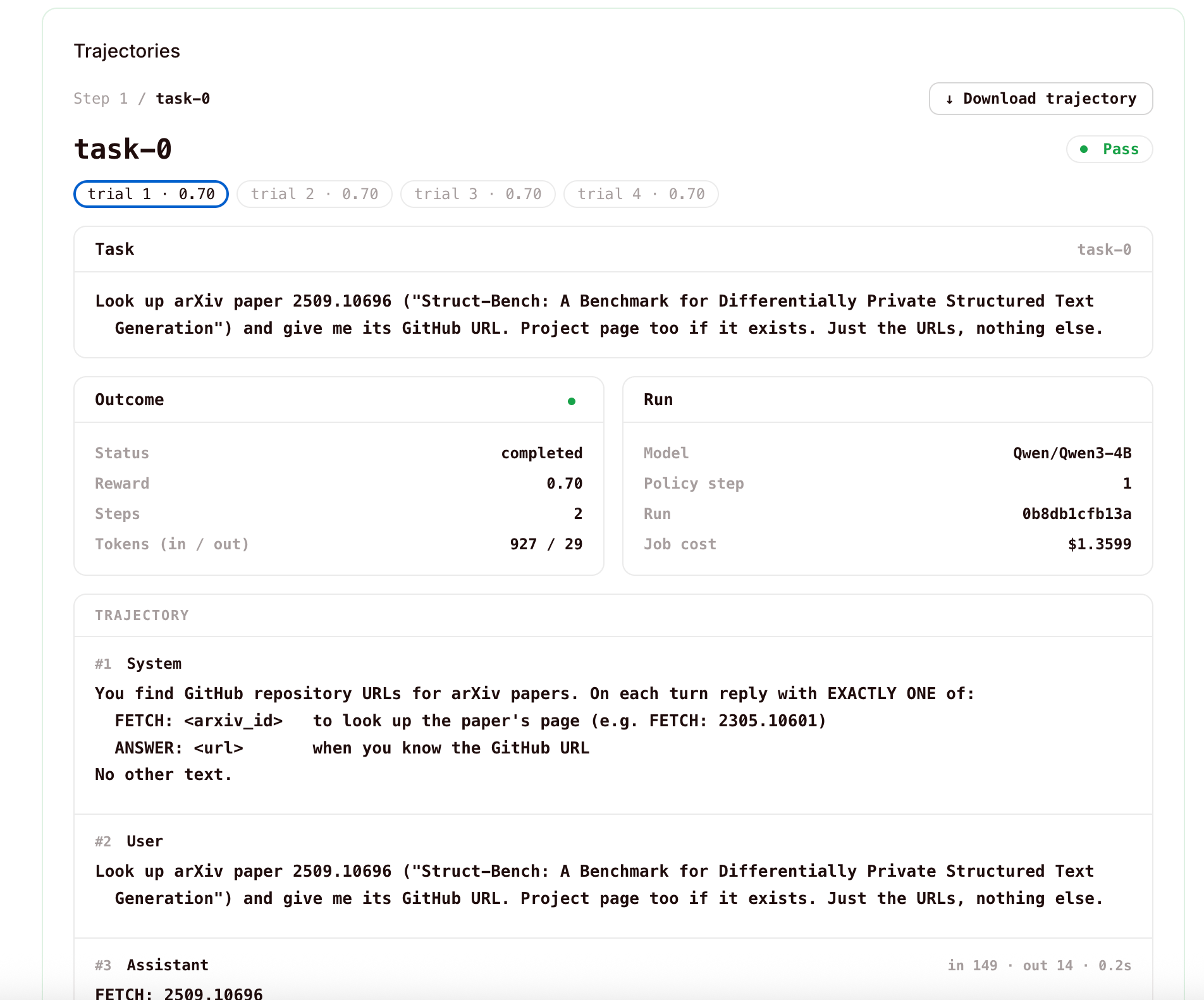 Download any trajectory as raw JSONL — or programmatically:
```python theme={null}
rows = client.training_jobs.trajectories(job_id, policy_step=10)
url = client.training_jobs.trajectory_download_url(job_id, rows[0]["id"])
```
The JSONL schema (rollout record, per-request spans, rendered episode) is documented in the open-source runtime: [trajectory-format.md](https://github.com/Veri-Studios/veri-runner/blob/main/docs/trajectory-format.md), with worked examples of rejected and fallback trajectories in the same repo.
## 6. Deploy the result
The trained checkpoint is on the job like any managed run — **Save as model**, then `veri deploy`, and point the same harness at the deployment endpoint.
## Config-file form
`veri run` accepts the same job as TOML. Upload the harness directory first (any `veri run-script ...` upload or `client.code_artifacts.upload(dir)` returns an artifact id), then:
```toml configs/harness.toml theme={null}
kind = "train"
[model]
base = "Qwen/Qwen3-4B"
[dataset]
id = ""
[reward]
id = ""
[resources]
gpu_type = "L4-24GB"
gpu_count = 4
[method]
type = "grpo_harness"
rollouts_per_prompt = 8
max_steps = 50
harness_protocol = "openai"
max_turns = 40
[harness]
base_image = "veri/base"
code_artifact_id = ""
entrypoint = "python agent.py"
```
Docs: [Harness-in-the-loop RL (reference)](/training/harness) · [Managed training](/training/managed) · [Reward functions](/training/reward-functions)
Download any trajectory as raw JSONL — or programmatically:
```python theme={null}
rows = client.training_jobs.trajectories(job_id, policy_step=10)
url = client.training_jobs.trajectory_download_url(job_id, rows[0]["id"])
```
The JSONL schema (rollout record, per-request spans, rendered episode) is documented in the open-source runtime: [trajectory-format.md](https://github.com/Veri-Studios/veri-runner/blob/main/docs/trajectory-format.md), with worked examples of rejected and fallback trajectories in the same repo.
## 6. Deploy the result
The trained checkpoint is on the job like any managed run — **Save as model**, then `veri deploy`, and point the same harness at the deployment endpoint.
## Config-file form
`veri run` accepts the same job as TOML. Upload the harness directory first (any `veri run-script ...` upload or `client.code_artifacts.upload(dir)` returns an artifact id), then:
```toml configs/harness.toml theme={null}
kind = "train"
[model]
base = "Qwen/Qwen3-4B"
[dataset]
id = ""
[reward]
id = ""
[resources]
gpu_type = "L4-24GB"
gpu_count = 4
[method]
type = "grpo_harness"
rollouts_per_prompt = 8
max_steps = 50
harness_protocol = "openai"
max_turns = 40
[harness]
base_image = "veri/base"
code_artifact_id = ""
entrypoint = "python agent.py"
```
Docs: [Harness-in-the-loop RL (reference)](/training/harness) · [Managed training](/training/managed) · [Reward functions](/training/reward-functions)